
 +44 20 3695 6722
 Sign in
This report examines the attack patterns and trends observed by StormWall analysts across the Middle East and North Africa during the first quarter of 2026 — a period that started relatively quietly and ended with the single biggest escalation of DDoS attacks the region has ever seen.
You might also want to read our global Q1 2025 DDoS report.
The Big Picture
Q1 2026 was the most active quarter for DDoS attacks in the MENA region ever recorded by StormWall. Overall attack volume increased by 574% year over year compared to Q1 2025 — the sharpest annual growth the company has seen to date.
Most of this increase occurred in March. January and February remained relatively stable, with most attacks linked to extortion groups and financially motivated threat actors, showing little deviation from Q4 2025 patterns.
The situation changed after the US–Israel–Iran conflict escalated on February 28, triggering a wider cyber conflict involving politically motivated groups from around the world. As a result, March alone accounted for more DDoS attacks in MENA than January and February combined.
At the same time, attacks became significantly more sophisticated. StormWall observed a sharp rise in advanced techniques such as multi-vector attacks, carpet bombing, and probing activity.
Multi-Vector Attacks Up 116% YoY
Most campaigns in MENA during Q1 2026 used between 6 and 20 attack vectors:
| Vectors per Campaign | Share of Attacks |
| 1 vector | 14% |
| 2–5 vectors | 31% |
| 6–20 vectors | 38% |
| 20+ vectors | 17% |
In March, hacktivist groups increasingly relied on DDoS-for-hire platforms preconfigured for multi-vector operations. Attackers also began launching attacks simultaneously across Layers 3, 4, and 7 rather than sequentially, forcing defenders to distribute mitigation resources across multiple attack types at once.
Carpet Bombing Attacks Up 81% YoY
Carpet bombing attacks rose by 81% year over year. This tactic is commonly used against ISPs and telecom providers because it maximizes disruption across shared infrastructure.
Instead of targeting a single IP address, attackers distribute traffic across an entire subnet. For example, a concentrated attack might immediately trigger alerts if traffic exceeds 100 Mbps per host. However, when the same volume of traffic is spread across a /24 subnet, each IP may only receive around 400 Mbps — low enough to evade many per-host detection thresholds.
In campaigns detected by StormWall, individual IPs often received 12 Mbps or less per wave, while upstream links and shared infrastructure still became saturated.
“Carpet bombing is rarely used on its own. In about 70% of MENA attacks, it was combined with DNS amplification, SYN floods, or TCP ACK floods, which is why most carpet bombing campaigns this quarter were also multi-vector,” says Ramil Khantimirov, Co-founder and CEO of StormWall.

Network Protection from DDoS Attacks
- Activate protection within 10 minutes
- 24/7 technical support
Probing Attacks Up 400% YoY
These attacks use low-volume traffic to test defenses and identify weaknesses before launching larger campaigns. The increase suggests that attackers are planning operations more carefully and targeting weak points more effectively — or only proceeding once vulnerabilities are confirmed.
Attack Distribution by Industry
Now let’s look at how DDoS attacks were spread across all industries in MENA in Q1 2026:
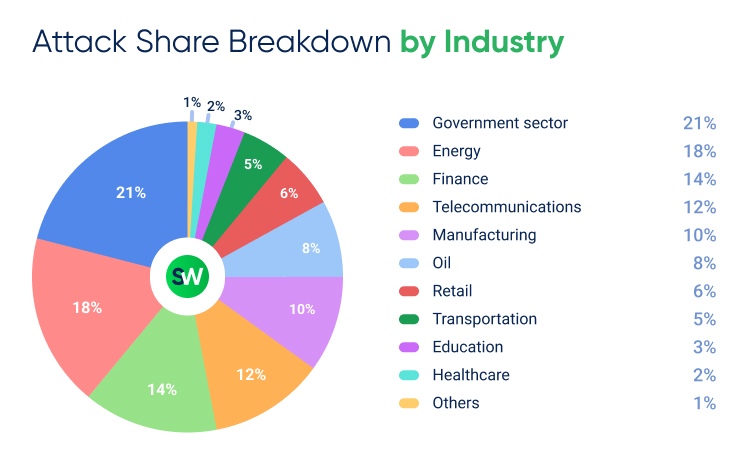
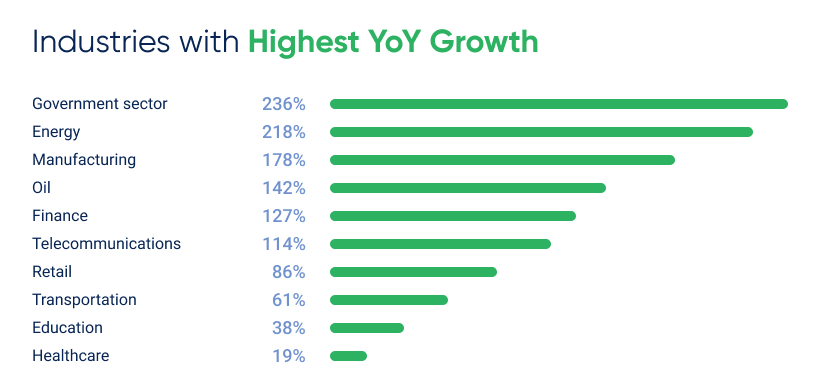
Here’s how the relative share of attacks shifted from Q1 2025 to Q1 2026:
- Government attacks grewfrom 14% to 21%, making it the most targeted sector in the region.
- Energy became the second most targeted industry at 18%, driven largely by hacktivist activity against critical infrastructure.
- Finance dropped from 21% to 14% of total attacks, despite absolute attack volume still increasing by 127% year over year.
- Telecommunications increased from 7% to 12%.
- Manufacturing more than doubled, rising from 4% to 10%.
- Retail saw the steepest decline, dropping from 36% to 6%.
- Transportation fell from 9% to 5%.
In Q1 2026, as the conflict between the US, Israel, and Iran pushed hacktivists to the front of the threat landscape, the focus shifted to high-profile, politically and strategically significant targets: government bodies, energy companies, and telecom infrastructure.
Relative Risk of DDoS by Sector
Which sectors were most likely to be attacked this quarter, and which were least? The table below shows the relative likelihood:
| Industry | Chance of Being Attacked |
| Government sector | ~1 in 4.5 |
| Energy | ~1 in 5.5 |
| Finance | ~1 in 7 |
| Telecommunications | ~1 in 8.5 |
| Manufacturing | 1 in 10 |
| Oil | ~1 in 12.5 |
| Retail | ~1 in 17 |
| Transportation | 1 in 20 |
| Education | ~1 in 33 |
| Healthcare | 1 in 50 |
| Others | 1 in 100 |
Note: These figures reflect relative risk within the MENA region based on observed attack distribution. Actual risk also depends on factors such as attack surface, security posture, and attacker interest.
In Detail: Top 3 Most Attacked Verticals
Government Sector
Government organizations became the most targeted sector in MENA during Q1 2026.
Following the US–Israel strikes against Iran, pro-Iranian hacktivist groups rapidly shifted toward attacking government websites across the region. Within 72 hours of the first strikes, approximately 150 DDoS claims were recorded against 110 organizations in 16 countries, with government entities accounting for nearly half of all targets.
Targets included Kuwaiti military and defense ministry websites, Saudi internal affairs systems, Bahraini government portals, and airport websites in Bahrain and the UAE, many of which experienced outages ranging from several minutes to several hours in early March.
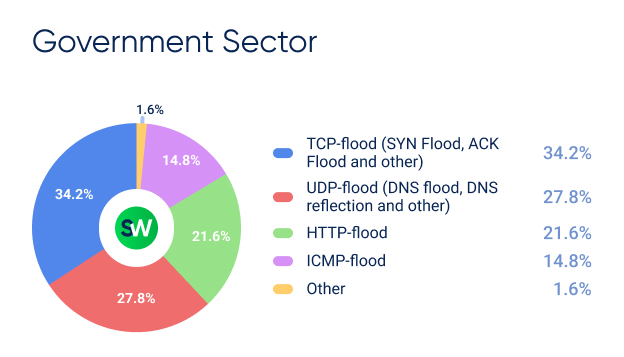
HTTP flood attacks made up a significantly larger share of attacks against government organizations than usual, as attackers prioritized highly visible public-facing services.
StormWall analysts also observed unprecedented coordination among hacktivist groups. A shared target-selection channel launched immediately after the strikes united more than 50 separate groups and published structured target lists covering Qatar, Bahrain, the UAE, Kuwait, and Saudi Arabia.
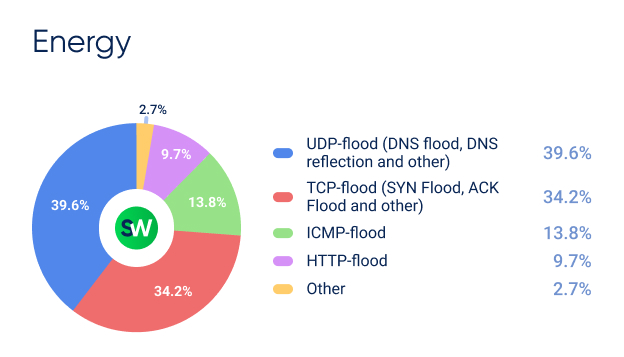
Energy
Energy became the second most attacked industry in MENA in Q1 2026. The sector rarely made the top 5 in previous quarters, but that changed in March. Hacktivist groups targeted energy companies because attacks on energy infrastructure generate significant attention and cause substantial economic disruption. Most attacks went after public-facing websites, corporate portals, and customer service APIs.
Finance
Finance was the most targeted industry in MENA during Q1 2025. In Q1 2026, however, its share of attacks declined from 21% to 14%, even though overall attack volume against the sector still increased by 127% year over year.
The sector faced a mix of financially motivated attackers and politically driven hacktivist groups. Beginning in March, attacks against Israeli banks and payment infrastructure increased significantly as part of the broader cyber conflict linked to Operation Epic Fury.
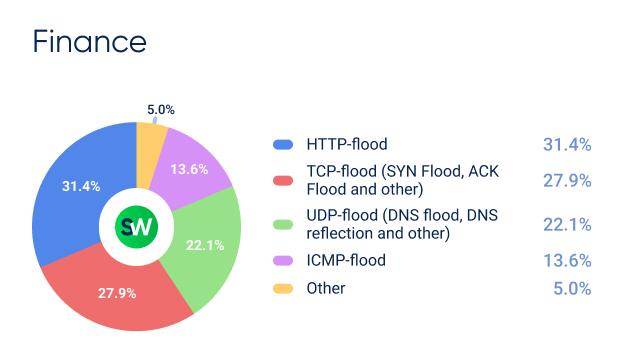
HTTP floods and API-layer attacks were the most common methods used against financial organizations. Attackers primarily targeted login systems, transaction APIs, and mobile banking endpoints — services where disruption has an immediate and visible impact on customers.
Most Targeted Countries in MENA
Here’s how DDoS attacks were distributed by country in MENA in Q1 2026:
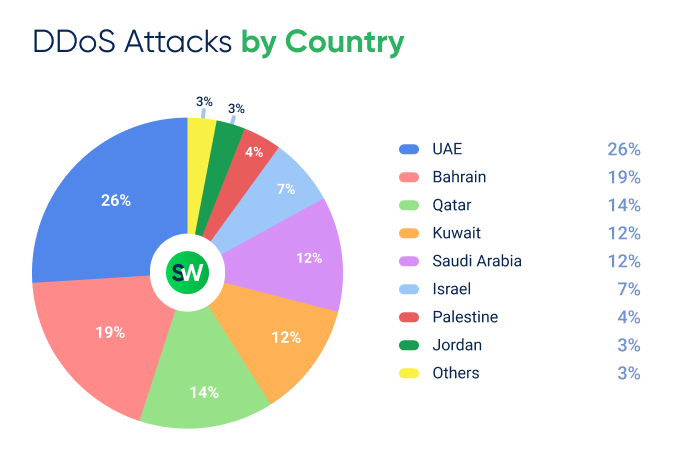
The UAE became the most targeted country in the region. Attacks against the UAE increased by 86% year over year, with its share of regional DDoS activity rising from 14% in Q1 2025 to 26%.
Bahrain ranked second, recording a 171% year-over-year increase, followed by Qatar in third place, where attacks rose by 75%.
Saudi Arabia’s share declined from 28% in Q1 2025 to 12% in Q1 2026 — a 57% decrease year over year. Although the country still experienced significant attack volume, other Gulf states absorbed a much larger portion of regional activity this quarter.
Compared to Q1 2025:
- UAE (+): 14% → 26%
- Bahrain (+): 7% → 19%
- Qatar (+): 8% → 14%
- Kuwait (+): 6% → 12%
- Saudi Arabia (–): 28% → 12%
- Israel (–): 11% → 7%
- Palestine (+): 2% → 4%
- Jordan (=): 3% → 3%
Wrapping Up
Q1 2026 confirmed that periods of geopolitical instability are increasingly accompanied by large-scale hacktivist and politically motivated cyber campaigns — especially in the MENA region.
The most notable development was the unprecedented 574% year-over-year increase in DDoS activity, the fastest growth StormWall has ever recorded in any region.
At the same time, the line between hacktivist and commercial threat actors continues to blur. Many groups now rely on the same DDoS-for-hire platforms, AI-assisted tools, and botnet infrastructure, making even non-political organizations potential targets.
These trends demonstrate that traditional DDoS preparedness is no longer demonstrate. Organizations now need always-on protection, real-time threat intelligence, and capacity planning designed for large-scale regional disruptions.
If your organization operates in a high-risk environment or relies on uninterrupted online services, we can help you strengthen your DDoS resilience and stay protected against evolving threats.

DDoS Protection for Websites
- Activate protection in 10 minutes
- 24/7 technical support
